IH Buenos Aires
Search
  • ih World
  • Aprender
    • Cursos anuales de inglés presenciales y online
    • Cursos Intensivos de Verano
    • Clases de inglés online a tu propio ritmo
    • Preparación IELTS
    • Post-Proficiency
    • Clases de español
    • Español Online
    • Programa Study Abroad
      • International House London
    • Inglés en Empresas
    • Auditorías de inglés en colegios
    • Clases gratuitas de inglés
  • Enseñar
    • Capacitación profesores
  • Contacto
  • Jobs
  • Idiomas
  • ih World
  • Aprender
    • Cursos anuales de inglés presenciales y online
    • Cursos Intensivos de Verano
    • Clases de inglés online a tu propio ritmo
    • Preparación IELTS
    • Post-Proficiency
    • Clases de español
    • Español Online
    • Programa Study Abroad
      • International House London
    • Inglés en Empresas
    • Auditorías de inglés en colegios
    • Clases gratuitas de inglés
  • Enseñar
    • Capacitación profesores
  • Contacto
  • Jobs
  • Idiomas

Activating the passive – Anya Shaw’s presentation – ABS Conference March 2012

Administrador2017-08-29T01:48:42-03:00

Activating the passive We teach the passive voice... The the passive voice is taught... Have a look in most coursebooks and this is how the passive is presented and practised. However, the challenge faced by students and teachers alike is not how it is formed or what it means but when and why it is used.  In Activating the Passive, these key questions, impliactions for the classroom and practical ideas will be explored.  Click here for ppt presentation: Activating the passive

Clem Duran’s story

Administrador2017-08-29T01:48:42-03:00
I have been asked to write something about my relationship with English; something to do with my first steps perhaps, or my difficulties or problems at Teacher Training College (the Profesorado), or even after that. After changing my mind several times I’ve chosen to start with some of my failures. This may sound rather off-putting but seen from a distance, some dire situations seem quite funny. So, here goes: To start with time and place: I was born in Rosario, in 1925 (!!) and as soon as I graduated (1945) I started working at ARCI (Asociación  Rosarina de Cultura Inglesa)  Two years later I was chosen to join a group that would travel to the UK to  spend 2 months in London and another month visiting universities where Spanish was taught: Oxford ,Cambridge,  York , Manchester, and several others. The tour was sponsored by the British Council. The idea was that as soon as we got back to Argentina a group of English university students would come to Argentina on a similar kind of tour. But every day I spent away the feeling that I didn’t want to go back to Argentina grew stronger. There was so much that was completely new to me; I was fascinated.  The fact that two of my best friends in the group had decided to stay on made me feel that this adventure would be easier than it proved to be. Both friends held British passports, which made all the difference. One of them had decided to stay for good and immediately got a job as a school teacher. She had already been teaching English in Córdoba. The other one didn’t have to work because her parents had bank accounts in England, which enabled her to enjoy a few months more just traveling around. I started my search for a job. It was painful. Wherever I tried to apply, the first question I was asked was: Have you got a Work Permit? Which I didn’t have and the interview was over. So I decided to get a Work Permit, but that was easier said than done. This time the question was: Have you got a job? Jobs were scarce and foreigners could only apply if there were not enough Britons with the necessary qualifications. So again the interview was over before it started. After many attempts, or so I thought, somebody connected me with a firm that sent articles on fashion to most countries in South America and they needed somebody who could translate the articles into Spanish. I was delighted with the idea. Success at last. Translating into one’s own language is much easier than the other way round. Furthermore, fashion doesn’t need technical knowledge of any particular science. It’s just every day language or jargon - or so I thought. I was given an article to translate, and I was allowed to take it home. I took it back to the office feeling confident and very pleased with myself. I had not realized that my boss was a Spaniard. He was horrified with my wonderful piece of work. He had underlined in red every other word. Some examples: a) He asked me what I meant by pollera (skirt). He said that for him that word meant a woman who sells chickens (pollos)!!! It could also have the meaning of a skirt but only in the context of clothes worn at the beginning of the 19th century, huge and held by hoops or crinoline to make them look wider. Most readers might never have heard the word in that context. It was news for me too, The correct translation for skirt was falda, b) I used the word angosta (narrow.) This was considered very old fashioned, poetical, suitable to describe a medieval street, for example. The corresponding word should have been estrecha. To make matters worse I had used this adjective with pollera. So the translation for a narrow skirt became, for the Spanish reader, a slim crinoline – what a contradiction in terms! c) Jacket was translated as saco. This word for a Spaniard meant bag or sack or something along those lines. He couldn’t see any connection with the rest of the text unless I meant that it was fashionable to wear clothes made of sackcloth or hessian!!! d) Overcoat should have been sobretodo, but I chose tapado which just made him laugh. And there were many more “mistakes”. Looking back, I don’t think they were that terrible, at least not for many Latin American Spanish speakers. Well anyway, my would-be-boss called me to her office to say I was getting the sack. She was a sweet elderly lady and tried to do her job without hurting me too much, but she was puzzled. She said“ I don’t understand. You are talking English to me and you say your mother tongue is Spanish... So back to square one. I crossed the street and found myself at the door of a Lyon’s Corner House. This was one of a huge chain of restaurants famous for their reasonable prices. (Note to back packers: they no longer exist so don’t get your hopes up) Even then they were far beyond what I could afford as a general rule, but for that once, a proper meal might just help stave off my incoming depression. Sitting at a real table with a table-cloth, a waiter to wait on me and a proper, printed menu etc. made me feel as if I belonged to the aristocracy. I read the menu and was surprised at the sight of an extremely cheap dish I had never heard of. The menu said : Chutney: (apples and tomatoes)  The price was ridiculously low - something like 10 % of the cost of anything else that I might choose. I imagined this was a sort of salad, a mixture of apples and tomatoes. So when the waiter asked what I would like I simply said: Chutney, please. Waiter: And what would you like the chutney with? Me: I just want chutney Waiter: But you can’t have just chutney. Me: Why not? This went on until the waiter produced a very tiny dish with very little sauce, just enough to add seasoning to something. That was when I learnt that chutney was a kind of sauce and that there were two kinds: one made of apples and the other made of tomatoes, but obviously you couldn’t order just the relish for a dish you hadn’t ordered. I felt very embarrassed, thanked the waiter and ordered fish and chips I can’t remember if I added chutney to my order.

Old Chestnuts …some tough nuts to crack by Lisa Phillips

Administrador2017-08-29T01:48:42-03:00
Image An “old chestnut” is a subject or joke that has been repeated so many times that it is no longer funny or interesting.  This is what I learnt from my Director (being from Australia, I’m lucky to even know what a chestnut is!), who wanted to discuss recurring issues that seem to plague even some of the most experienced teachers.  Looking back through past observation reports, we came to realize that we were seeing the same old problems again and again.  Essentially classroom management issues, we believe these “chestnuts” are fundamental to a good learning environment and are the foundations for good teaching practice.  How to change the “old chestnuts” into fresh, tasty treats was the challenge.  The slogans that follow are the result of a brainstorming session with the teachers of International House Buenos Aires (Recoleta), with the aim of making these points memorable for everyone involved.
  1. Voice, your choice!
Much is said about the need to simplify your language for lower level learners and this is no doubt true.  But what about those who are more advanced?  The primary source of input for students is often the language in the classroom, so this needs to be of high quality. It may require us to simplify or increase the complexity of the language we would ordinarily use.  The way the voice is used is also important.  The voice is just another tool and needs to be trained to be effective.  For example, a slightly longer pause allows the learner value processing time.  Use a confident, clear voice – if you don’t sound sure, how can your students be? While the idea that “students need to get used to natural speech” has its place, the place for authentic listening in the classroom is within the framework of a controlled listening lesson with proper support.  Not being conscious of the effect of your voice is just laziness.
  1. The lesson is not over until the homework is done.
Homework is not additional part of the lesson but an integral part of it.  How much is set is up to the individual institute, but is should be varied, relevant, meaningful, doable and as enjoyable as possible.  It should also be written clearly on the whiteboard so that students know exactly what they are supposed to do and can copy it down, and checked using a variety of methods. The homework may even provide the subject matter or material for the following class.
  1. All a-board!
The teacher’s number one visual tool is the whiteboard.  It is from here that students copy down a record of the class to take away for self-study, so it is vital that this be legible, logical and carefully planned.  A vocabulary column down one side and use of different colours consistently are healthy routines which allow work to stay on the board and be revisited during the class.  This can then also cross over into your learners’ notes, so scrappy, odd vocabulary scattered around willy-nilly is not allowed.
  1. What day is it?  It’s ti-day!
This one is self explanatory.  Cleaning your whiteboard, putting chairs back into place and returning any other resources to the appropriate places in the teachers’ room or library just makes everyone’s lives easier.
  1. Mind the gap!
Class dynamics are affected by the way in which the space is used.  There is a tendency for students to put their chairs in a line against the wall in a “judging panel” formation.  Instead, get them into a tight semi-circle with no gaps between them (bags and jumpers can go elsewhere) and if space allows, move away from the wall.  This lets all members of the group make eye contact, and also gives the teacher a good monitoring position behind the students.  Encourage students to fill out the seats from the middle, leaving a seat or two near the door free for latecomers.  This helps to avoid disruption. 
  1. Oi, you!
Ever been into a class halfway through the year and heard, “You know…… her”?  Obviously, the teacher needs to know and start using the students’ names as soon as possible, but it is also important to spend some time getting the students to learn them too.  This is extremely important for class dynamics, bonding and rapport.  And don’t forget those who join a little later on.  Repeat these ‘getting to know you’ activities after one week, one month, whatever is necessary to build a community of learners, and give your classes that personal touch by using their names or nicknames as much as possible.
  1. Instructions or ructions?
Give clear instructions in stages and concept check the learners’ understanding.  This is given a lot of attention on CELTA courses, and it often those teachers who are fresh out of one who do it best.  Old lazy habits can set in quickly, so we can make sure even the slowest students understand by doing an example across class, writing instructions on the board, showing the page and asking for repetition by a class member.  Pause, and think before you speak.  Keep instructions clear, short and to the point.  Check understanding by asking closed concept questions, followed by open ended ones.  And remember – ‘Is that clear?’ and ‘Does everyone understand?’ do not count!
  1. A little a day keeps the ADoS away.
Unfortunately, administrative paperwork can’t be avoided but keeping it up-to-date should stop it getting out of hand.  Whether this is absences, homework records, exam scores or your students’ frequently occurring errors, this data not only is a requisite of the job but makes you appear more professional.  Regular liaisons with the office also help to provide clear channels of communication and in turn, smoother operation of an institute from the front desk to the classroom.
  1. Cas-te-lla-no – don’t let it go.
Of course we want our students to speak as much English as possible in classes, however, there is sometimes a place for the learner’s L1 (in this case, Castellano).  If someone is upset or doesn’t know how to say something, it makes sense to use this resource if you have it at your disposal.  Make sure you give your students the classroom language they need to communicate in English during the lesson, and establish your expectations of when it is acceptable to use the L1.
  1. On your bike, again?
Finally, this cryptic crossword style clue refers to recycling.  Nation (2001) says that it’s necessary to encounter a lexical item in different contexts between 8 – 12 times to know it, and that spaced repetition with insertion into previously learnt language over time is more effective than massed into 1 or 2 exposures.  Varying your techniques to appeal to different learning styles and keeping and using vocabulary bags are a couple of principles that the teachers here have taken on board. Games, too, have a valid place and collocation work becomes increasingly important at higher levels.  Learner training also falls into this category, and it is essential to give students at all levels the tools they need to become successful language learners e.g. ways of recording vocabulary. Since coining these slogans, the frequency of these problems in observations has reduced.  I have heard some teachers in conversation about their feedback commenting on the number of “chestnuts” they had broken, and being determined to improve upon this next time.  There is a poster on the back wall of every classroom in the institute to remind us of these good teaching practices.  Some of them are specific to our teaching context here at IH Buenos Aires (Recoleta), but the essence can be transferred to almost any situation. When we have these basic principles in place, we have more opportunities to experiment and develop our teaching practices and methodologies.  As some wise bloke once said, “You have to know the rules before you can break them”.  References Hedge, T.  (2000)  Teaching and Learning in the Language Classroom. Oxford University Press. Nation, P.  (2001)  Learning Vocabulary in Another Language. Cambridge University Press. Scrivener, J.    (1998)  Learning Teaching. Macmillan.

Online Teacher-Training courses with IHWO

Administrador2017-08-29T01:48:42-03:00

Bruce Thompson – Buenos Aires Herald interview – 7th August 2011

Administrador2017-08-29T01:48:42-03:00
newspaper_note-bruce-thompson mod  

CELTA & DELTA at International House Buenos Aires

Administrador2017-08-29T01:48:42-03:00

CELTA & DELTA at International House

On Friday 8th July 2011, Bruce Thompson and Neil McMahon presented the CELTA and DELTA options available at International House Buenos Aires.  Here are the slides from that presentation, which explain what a CELTA would give to teachers already teaching locally and who have a profesorado, and then how the DELTA Modules will build on those qualifications and the range of experience a teacher has in order to take them to the top of their profession. Please email info@ih-buenosaires.com if you have further questions or comments about either of these courses.

2.0 Web or not 2.0 Web – the teaching kids with technology question

Administrador2017-08-29T01:48:42-03:00
Neil McMahon – neil@ih-buenosaires.com

Part Two – Lots more practical examples and links to the websites...

Friday May 13th 2011 I presented a workshop with this title at the ABS Young Learners Conference in Buenos Aires. Below are the slides and links I used in the presentation for those of you that were there and for those of you that weren’t too. During the session we thought about further ways of exploiting these links – if you have any please share them with us here by commenting at the end of the blog post. We’d love to hear what you thought of the talk too!

2.0 Web or not 2.0 Web

2.0 Web or not 2.0 Web – the teaching kids with technology question

Administrador2017-08-29T01:48:42-03:00
Neil McMahon – neil@ih-buenosaires.com

Part One – A little bit of theory and a practical example...

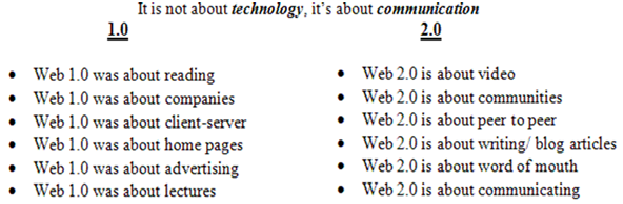
Friday May 13th 2011 I presented a workshop with this title at the ABS Young Learners Conference in Buenos Aires. Below are the slides and links I used in the presentation for those of you that were there and for those of you that weren’t too. During the session we thought about further ways of exploiting these links – if you have any please share them with us here by commenting at the end of the blog post. We’d love to hear what you thought of the talk too! Abstract 2.0 web or not 2.0 web addresses the question of whether it’s worth all the hassle, extra work and learning that jumping on the technology bandwagon inevitably entails. Will our kids learners really be motivated and challenged by using the gadgets they’re obsessed with outside class inside the classroom as well (not to mention for homework)? During the session we’ll be looking at an array of applications and activities that provide this motivation and challenge for the students, while keeping the extra work for the teacher to a minimum. Come and join us for a practical, fun session full of ideas to get your kids weaving their English learning webs. First of all we discussed the differences between Web 1.0 and Web 2.0 – what can we do now that we couldn’t do before? Well now it’s a two-way process – so let’s get our kids involved in that process – let’s get them communicating! Wordle.net We can use Wordle for: Lesson reviews,  Vocab lists,  Personal profiles,  Story summaries,   Unit revision posters,  Find the English words,  Word soups,  Graphic organisers,  Make your own We used Wordle as an intro to the session to show the power of simple ideas that can be used time and time again. It’s also a good example of how to combat the issues that teachers face when dealing with technology that sometimes discourage us from using it with our young learners. Issues? What issues... To overcome these issues we need a change of attitude – let’s go on a PICNIC – Problem In Chair, Not In Computer!
  • Don’t be afraid, you’ve been to this session or read this blog now so you have the confidence to begin
  • You want your students to be risk takers, so you should be too!
  • Train yourself and ask for help. Coming to this session is a good start. Use Twitter to find out more. Read some blogs to get you going. Try, try and try again.
  • Ideas will come once you start using. Trial and error. Share and share alike (check out the comments section below and add your own)
  • Short term pain, long term gain. Share and share alike. Repeat to fade.
  • Be safe, keep in control. Ask parents to help. Communicate. Use safe sites...
  • Grade the task not the text. Control the surf. Use the suggestions below...
So in Part Two of this blog post (coming soon) we’ll look at more ideas like Wordle that will help you to start using technology with your kids to learn and enjoy English. Looking forward to your comments and suggestions for favourite websites to use with young learners! Neil McMahon, Buenos Aires, 16/5/11

Motivating your students: A 10-step guide – By Hugh Dellar

Administrador2017-08-29T01:48:43-03:00
Hugh Dellar Motivating your students article

DOS Conference – Filmed sessions

Administrador2017-08-29T01:48:43-03:00
Filmed sessions from the recent DOS Conference online: External sessions can be accessed either through the banner on our homepage or by clicking http://www.ihworld.com/video/category.asp?c=5. Internal sessions can be accessed by clicking http://www.ihworld.com/an/video/category.asp?c=6. Please remember that you will need your username and password to view the internal sessions. We are working on adding the powerpoint sessions to the video pages, however in the meantime you can access the powerpoints at http://www.ihworld.com/an/conferences/dos2011/presentations.asp. International House World Organisation
  Prev123Next  
[porto_block id="5966" tracking="layout-footer-5966"]